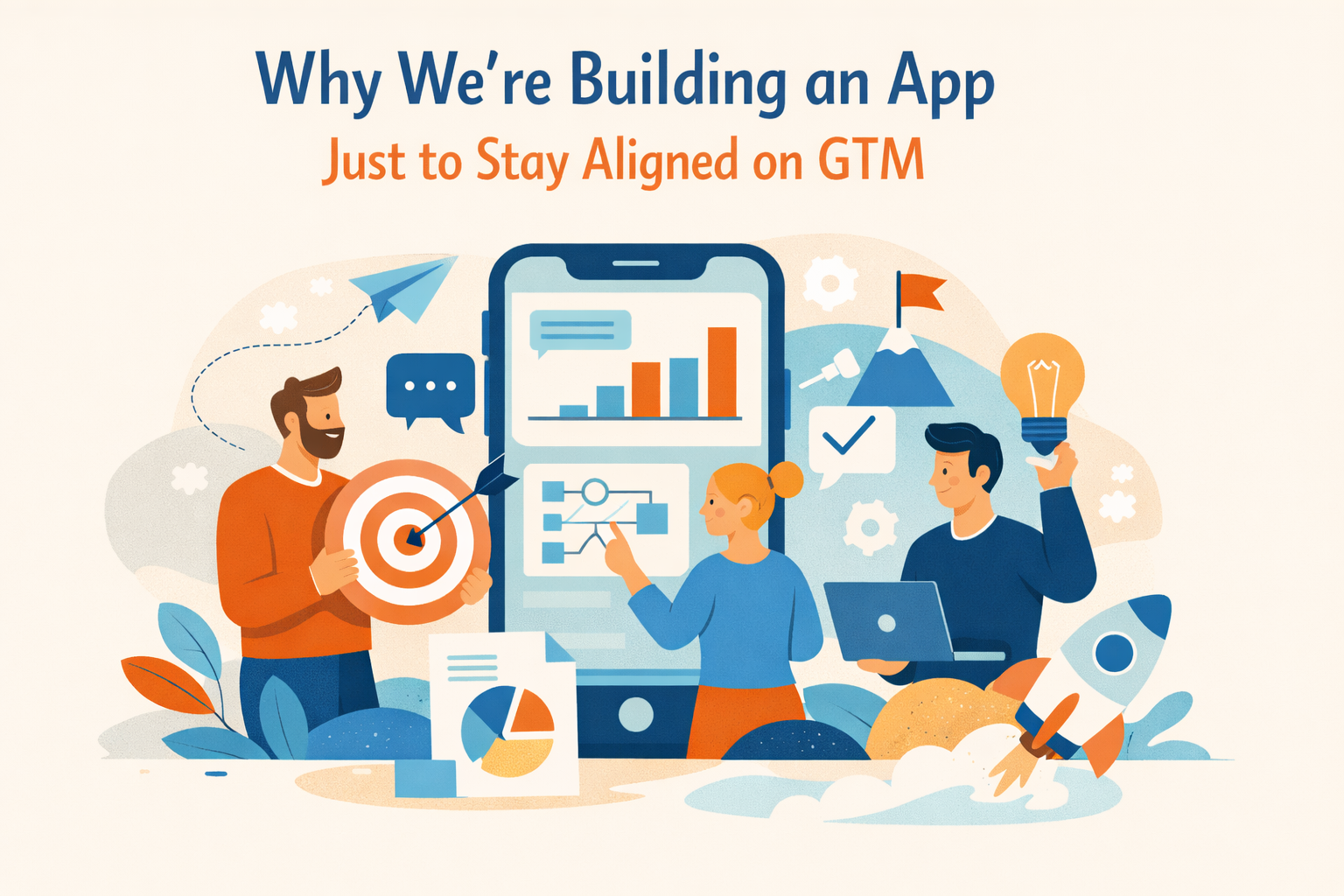
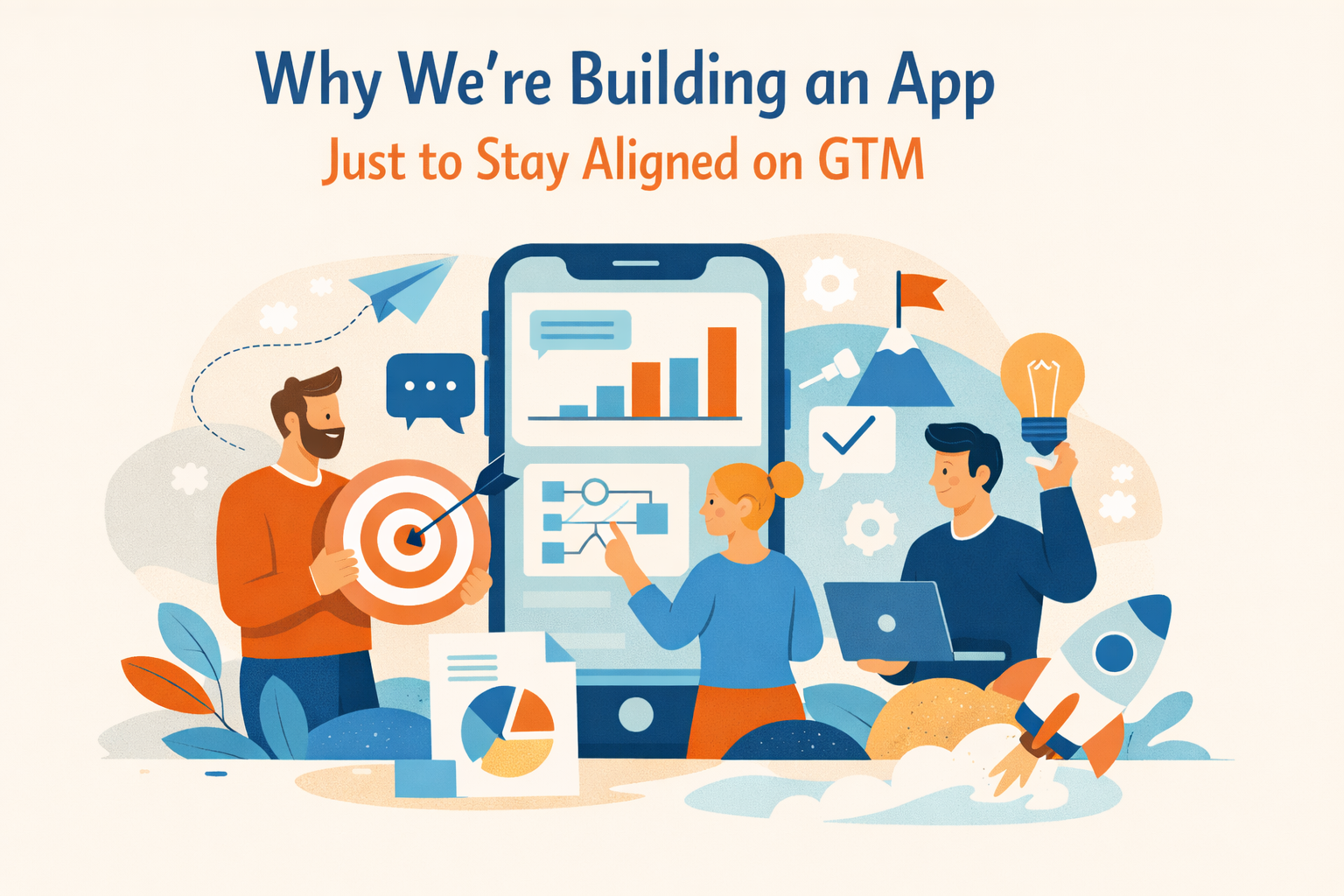
Why We’re Building an App Just to Stay Aligned on GTM
Every company says alignment matters.
Very few companies build systems that actually enforce it.
After working across hardware, SaaS, infrastructure, and B2B services, one pattern keeps repeating: go-to-market failure is rarely about strategy. It’s about misalignment.
Marketing thinks they are driving demand.
Sales thinks marketing does not understand the buyer.
Product thinks GTM does not reflect reality.
Leadership assumes everyone is rowing in the same direction.
They are not.
The Real GTM Problem No One Talks About
Most GTM initiatives fail long before launch because alignment lives in:
Slide decks
Notion docs
Slack threads
One-off meetings
Tribal knowledge
None of those scale. None of them stay current. And none of them create accountability.
What happens instead is predictable:
Messaging drifts
ICP definitions blur
Sales creates their own pitch
Marketing optimizes for clicks, not revenue
Product launches features GTM is not ready to sell
The result is wasted spend, longer sales cycles, and internal frustration.
Alignment Is a System Problem, Not a People Problem
The mistake companies make is treating alignment as a communication issue.
It is not.
It is a systems issue.
If GTM alignment relies on memory, meetings, or “everyone being on the same page,” it will break the moment:
You hire new people
You launch a new product
You enter a new market
You change pricing
You raise capital
Alignment needs infrastructure.
Why We’re Building an App for GTM Alignment
We are building an app with a simple goal:
Make GTM alignment unavoidable.
Not another dashboard.
Not another CRM.
Not another planning doc.
A single source of truth that connects:
ICP definitions
Buyer personas
Value propositions
Messaging pillars
Pricing logic
Sales motions
Content themes
Active initiatives
And ties them directly to execution.
If something changes in one place, it is visible everywhere.
What the App Enforces by Design
1. One GTM Source of Truth
No duplicate docs. No competing narratives. Everyone works from the same live system.
2. Explicit Ownership
Every GTM initiative has an owner, a rationale, and a success metric. No “I thought someone else was handling that.”
3. Initiative-Level Alignment
Before anything launches, it must map to:
A defined ICP
A specific pain
A clear value proposition
A supported sales motion
If it does not, it does not ship.
4. Sales and Marketing in the Same System
No more sales decks drifting away from marketing strategy.
No more marketing campaigns sales cannot use.
5. Living Strategy, Not Static Strategy
GTM is not a quarterly exercise. It evolves weekly. The system reflects that reality.
The Hidden Benefit: Speed Without Chaos
The irony is that alignment systems do not slow teams down.
They speed them up.
When alignment is clear:
Decisions happen faster
Launches are cleaner
Feedback loops tighten
Teams argue less and execute more
Velocity comes from clarity, not urgency.
Who This Matters For
If you are:
A founder scaling past product-market fit
A GTM leader tired of herding cats
A sales leader fighting message drift
A product leader frustrated by launches falling flat
You do not need more meetings.
You need better infrastructure.
Final Thought
Most companies treat GTM alignment like a culture issue.
Culture matters, but culture without systems does not scale.
We are building this app because we are done pretending alignment “just happens.”
It should be designed.
It should be enforced.
And it should be visible to everyone involved.
If GTM is how your company grows, alignment deserves the same level of product thinking as the thing you are selling.